 EN
EN


The high-end stone market is currently experiencing an unprecedented transformation. In the first quarter of 2025, the average import price of marble raw blocks in China increased by 6.3% year-on-year, yet simultaneously, the Shuitou stone market has witnessed price reductions across various varieties, including Calacatta. This seemingly contradictory market phenomenon reflects the deep structural adjustments occurring in the stone industry's supply and demand. As a stone trade practitioner, how to make an informed choice between Carrara White and Calacatta—two classic high-end stone varieties—has become crucial for project decision-making. This article provides you with a systematic cost-effectiveness evaluation guide from a professional perspective.
I. Stone Characteristics Comparison: In-Depth Analysis of Mineral Composition and Physical Properties
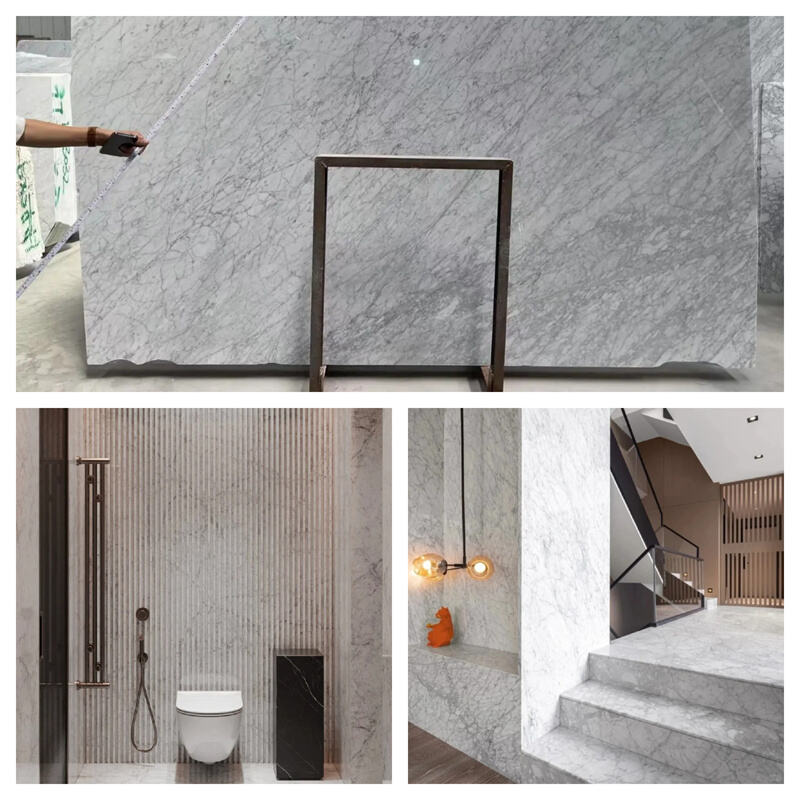
Carrara White Marble originates from the Carrara quarries in Italy, with its mineral composition dominated by calcite, accounting for over 95%, supplemented by small amounts of dolomite and quartz. The most distinctive feature of this stone is its gray and white network-like veins, presenting a modern and minimalist aesthetic style. According to physical performance test data, Carrara White has a Mohs hardness between 3-4, compressive strength typically ranging from 70-90 MPa, and water absorption of approximately 0.2%-0.5%. Notably, Carrara White exhibits relatively high oil content, density, and hardness, making it perform exceptionally well in terms of wear resistance and stain resistance, which is why it is regarded as an "elegant yet affordable" quality stone.
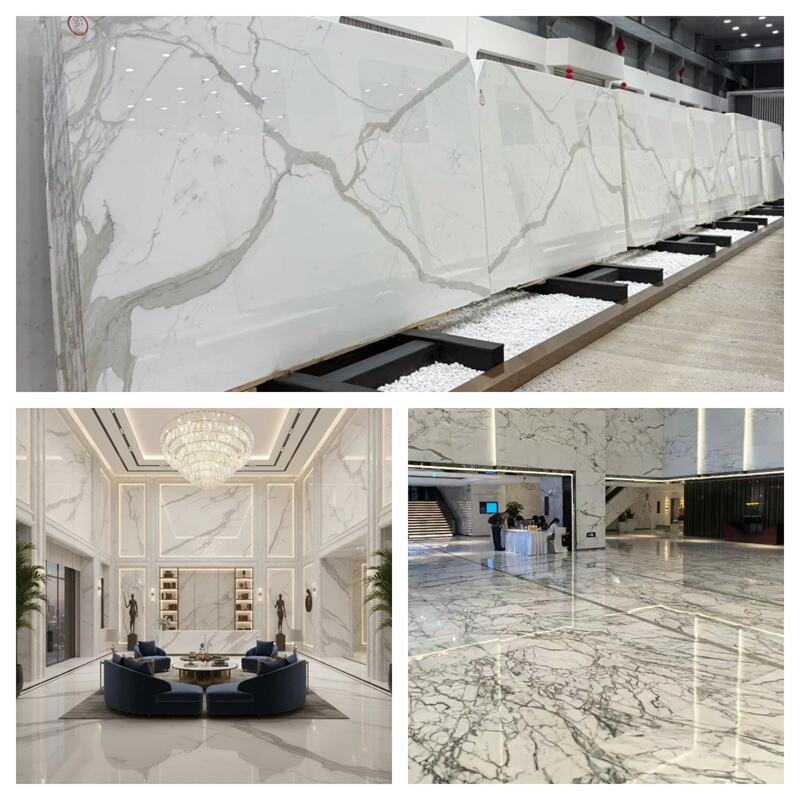
Calacatta Stone also originates from the Carrara quarries in Italy, but its mineral composition is more complex, with calcite content approximately 92%-95%, containing small amounts of talc and illite. This special mineral combination endows Calacatta with its unique cloud-like veining pattern. Calacatta's Mohs hardness is similarly 3-4, while its compressive strength can exceed 100 MPa, slightly higher than Carrara White, with water absorption controlled below 0.2%. From an aesthetic perspective, Calacatta's base color is off-white, interlaced with gray or golden veins, resembling a sea of clouds at dawn, possessing strong dynamic beauty, making it a popular choice for high-end interior decoration.
Differences in Origin: Although both originate from the Carrara quarries in Italy, they come from different specific quarry sites. Carrara White has relatively more quarry sites, with annual mining volume accounting for over 25% of global marble production, while Calacatta comes from only a few high-quality veins, with annual mining volume accounting for less than 0.5% of global marble production, indicating significantly higher scarcity.
II. Application Scenario Analysis: Precise Recommendations for Different Project Types
Residential Decoration Scenarios: For high-end residential projects such as villas and luxury apartments, Calacatta is an ideal choice for kitchen countertops, bathroom spaces, and feature walls. Its delicate texture can create a luxurious yet warm living atmosphere, particularly in open-plan kitchens and master bathroom spaces, significantly elevating the overall quality of the project. For small to medium-sized apartments or home decoration with relatively limited budgets, Carrara White represents a more economical choice. Its modern minimalist style aligns perfectly with Nordic and luxury-minimalist design concepts, making it a representative of marble cost-effectiveness with a price range of 200-500 RMB per square meter.
Commercial Space Scenarios: Commercial projects such as luxury hotel lobbies, designer boutiques, and office building lobbies have extremely high requirements for stone quality. Calacatta, with its scarcity and artistic value, has become the preferred stone for five-star hotels and luxury brand stores. According to industry data, a five-star hotel project using Calacatta marble paving for its lobby floor had a construction cost exceeding 2,000 RMB per square meter, becoming a project highlight due to its unique visual effects. For commercial spaces such as mid-to-high-end shopping malls and boutique hotels, Carrara White can balance cost control with aesthetic presentation, with its stable supply and reasonable pricing making it more suitable for large-scale applications.
Public Building Scenarios: For public buildings such as museums, art galleries, and government office buildings, Calacatta's artistic value and cultural connotations can perfectly align with the functional positioning of the architecture. In spaces requiring emphasis on cultural heritage and artistic atmosphere, Calacatta is undoubtedly the best choice. For public facilities such as schools and hospitals, Carrara White becomes the superior choice due to its higher cost-effectiveness and more stable supply.
III. Cost-Benefit Analysis: Deep Deconstruction of Full-Chain Cost Structure
Procurement Cost Comparison: According to the latest market data, Italian Carrara White ranges in price from 200-500 RMB per square meter (for quality grade), while high-end varieties can reach 1,800-2,500 RMB/㎡; Calacatta prices are generally higher, with quality Calacatta typically priced between 800-5,000 RMB/㎡, 2-3 times that of Carrara White. From international import data perspective, in 2025, China's average import price for Italian stone was approximately 553 USD per ton, while Calacatta and other high-end varieties had prices significantly above the average level.
Processing Difficulty and Costs: Processing of Carrara White is relatively simple, with cutting, grinding, and polishing having relatively low waste rates of approximately 8%-12%; Calacatta's processing is more challenging, its irregular cloud-like veins require manual selection and CNC cutting technology to ensure vein continuity across each slab, with waste rates reaching as high as 30%. This means that for the same raw block volume, Calacatta produces significantly fewer usable finished slabs than Carrara White, substantially increasing processing costs. According to industry statistics, Calacatta's processing costs are 20%-30% higher than Carrara White.
Transportation Cost Comparison: Both stone varieties require import from Italy, so transportation costs are basically similar. However, it should be noted that due to Calacatta's scarcity and higher value, transportation insurance costs are relatively higher. Additionally, because Calacatta's processing is more difficult, some processing stages need to be completed in Italy before shipping to China, further increasing transportation costs. Overall, transportation costs account for approximately 15%-25% of total stone project costs.
Installation Cost Analysis: Installation of Carrara White is relatively straightforward, with waste rates approximately 10%-15%, and installation costs between 60-100 RMB/㎡; Calacatta installation requires more professional technical teams, with waste rates potentially reaching 20%-25%, and installation costs between 100-200 RMB/㎡, with paving patterns reaching as high as 150-300 RMB/㎡. Additionally, Calacatta has higher requirements for installation environments, requiring stricter temperature and humidity control, which indirectly increases project costs.
Cost-Effectiveness Assessment Model: Comprehensively considering procurement costs, processing costs, transportation costs, and installation costs, Carrara White's comprehensive cost is approximately 40%-60% of Calacatta's. However, when evaluating from the perspective of service life and maintenance costs, there is little difference in maintenance expenses for both stones, both requiring regular protective treatments (such as waxing and sealing). Therefore, for projects with limited budgets but desiring high-end stone effects, Carrara White is the superior choice; for projects with ample budgets pursuing ultimate artistic effects, Calacatta's value is better reflected.
IV. Market Trend Insights: Deep Interpretation of International Stone Trade Data
Supply and Demand Status Analysis: According to General Administration of Customs statistics, from January to April 2025, China imported 1.073 million tons of marble raw blocks, a slight year-on-year increase of 1.8%, but import value reached 682 million USD, a year-on-year increase of 8.4%, indicating significant improvement in unit value. Among them, the average import price from Italy was 1,860 USD per ton, a year-on-year increase of 7.2%; Turkey was 1,240 USD per ton, with an increase of 9.5%. This indicates that imported prices of high-end stones continue to rise, yet market demand for quality stones remains growing.
However, the domestic market presents a different picture. Currently, the Shuitou stone market has high inventory levels, with over 100,000 cubic meters of raw blocks and 1 million square meters of premium slabs in core storage areas. Some enterprises maintain single-category inventory (such as Calacatta) at levels between 5,000-20,000 square meters for long periods. In Q3 2025, Shuitou market slab turnover rate decreased by 28% year-on-year, with some enterprises forced to liquidate inventory with price reductions of 15%-20%. This supply-demand mismatch phenomenon is primarily caused by the sluggish real estate market and consumer downgrading trends.
Price Volatility Factors: High-end stone prices are influenced by multiple factors. Resource scarcity is the most fundamental determining factor—high-end stones like Cold Jade have seen prices rise from a few hundred to over ten thousand RMB per square meter due to mine closures. Market design style popularity is also an important factor—when certain stones align with mainstream market design styles and get promoted by designers and social media, their prices rise rapidly. Brand effects are equally not to be ignored. Bulgari stone has seen significant market demand growth due to brand endorsement and social media promotion, naturally commanding premium prices.
Future Trend Predictions: According to the "2023 China Stone Industry Development Annual Report" released by the China Stone Association, the average service life of large-scale stone mines above designated size in China is less than 12 years, and high-quality mines are increasingly depleted. The Italian government has announced that starting from 2026, it will implement annual mining quotas for Carrara quarries, setting an annual production ceiling of 4.5 million tons, a 12% reduction from current levels, which will further tighten the global supply of high-end white raw blocks. It is expected that from 2025-2030, China's imported marble raw block average price growth will maintain at 5%-7% annually.
Simultaneously, with accelerated green mine construction and dual-carbon emission control policies, it is expected that domestic raw block annual growth will slow to 3.2% from 2026-2029. Leading enterprises are gradually building a globalized resource supply system through overseas mine acquisitions and equity mine layouts. According to incomplete statistics, by the end of 2023, Chinese capital had directly invested in or controlled over 30 beige marble mines in Turkey, Greece, Iran, and other countries, with annual controlled raw block volume exceeding 2 million cubic meters, accounting for approximately 25% of China's imported beige raw block volume.
V. Selection Decision Guide: Six Practical Evaluation Criteria
Based on the above analysis, we provide you with the following six practical evaluation criteria to help you make the optimal choice based on your project budget, design style, and usage environment:
1. Project Budget Assessment: For projects with budgets under 300 RMB/㎡, it is recommended to choose Carrara White or its domestic alternatives; for projects with budgets between 300-800 RMB/㎡, Carrara White is the most cost-effective choice; for projects with budgets between 800-2,000 RMB/㎡, you can consider quality Carrara White or ordinary Calacatta; for projects with budgets above 2,000 RMB/㎡, you can boldly select top-tier Calacatta.
2. Design Style Matching: For projects with modern minimalist, Nordic, and luxury-minimalist styles, Carrara White is the ideal choice; for European luxury and Italian high-end styles, Calacatta can perfectly present design intentions. It is recommended to clearly define the project's design style positioning before selecting stone to avoid effect discounts caused by style-stone mismatches.
3. Usage Environment Consideration: For high-traffic, high-frequency use areas (such as hotel lobbies, shopping mall floors), it is recommended to choose Carrara White, which has higher hardness and better wear resistance; for key decorative areas (such as feature walls, reception desks), you can choose Calacatta to elevate space quality; for humid environments (such as bathrooms, kitchens), both stones are suitable, but proper protective treatment is necessary.
4. Supply Cycle Assessment: For projects with tight schedules, Carrara White is the safer choice with relatively stable supply and shorter cycles from order to delivery; while Calacatta, due to its high scarcity, may have procurement cycles as long as 45-60 days, requiring reservation during the early project planning stages.
5. Long-Term Maintenance Costs: Both stones require regular protective treatments, but Calacatta has higher maintenance requirements, requiring more professional maintenance teams and more frequent maintenance cycles. If the project lacks professional stone maintenance teams, it is recommended to choose Carrara White to reduce long-term maintenance costs.
6. Value Creation Capability: From the perspective of asset appreciation evaluation, top-tier Calacatta can bring significant brand premiums and appreciation space to high-end projects, suitable for projects requiring emphasis on scarcity and uniqueness; for mass-market projects, Carrara White can provide excellent aesthetic effects while controlling costs, making its cost-effectiveness advantage more evident.
Conclusion
Making a choice between Carrara White and Calacatta is essentially a trade-off in project value positioning. Carrara White, with its moderate price, stable supply, and modern minimalist aesthetic style, has become a model of marble cost-effectiveness; Calacatta, with its scarcity, artistic value, and luxurious feel, has become the darling of the high-end stone market. Against the backdrop of the current deep adjustments in the stone industry, whether for imported stone selection or stone project cost control, rational decisions need to be made based on professional knowledge and market insights. It is recommended that project decision-makers not only focus on unit procurement prices but also comprehensively evaluate full-chain costs from raw materials to installation, as well as the value creation capability of stones throughout their entire lifecycle. After all, quality stone can be passed down for centuries, with value far beyond the initial purchase price.
Mission: To deliver superior stone materials through precise craftsmanship, sustainable sourcing, and innovative surface technologies—enhancing the quality, durability, and beauty of every space we touch.
Vision: To become a global leader in high-end stone solutions, redefining modern architecture and interior design with materials that combine natural elegance, advanced performance, and environmental responsibility.
Slogan: Stronger. Smarter. More Beautiful. Better.